Sofya at Mayo Clinic Platform: from real-time reasoning to precision care
In Rochester, Sofya presented a research direction connecting longitudinal data, disease foundation models, and care gaps to reviewable clinical action.
At the Mayo Clinic Platform_Accelerate final showcase in Rochester, Sofya presented a question more demanding than demonstrating a strong model: how can precision care operate at scale, inside the context of each health system? The proposed direction combines automated real-time clinical reasoning with a longitudinal representation connecting risk, care, and outcomes.
The real test is changing what can still change
Clinical intelligence matters only when it arrives in time to support a decision. That moves the product's center of gravity from the finished note to the still-open plan: recognize what changed, assemble the relevant context, make limits explicit, and return a hypothesis that a professional can review.
precision care · research direction
From longitudinal data to care that can still change.
The final presentation organized the research as one flow: represent the journey, create clinical references, measure distances, and turn recurring deviations into reviewable gaps.
Longitudinal journey
Risk, care, and outcomes are aligned across time before any comparison is made.
Disease references
Literature, guidelines, clustering, and expert review form clinical anchors.
Patient in context
Each case is compared with relevant care dimensions without erasing its singularity.
Reviewable action
Recurring patterns make care variation and opportunities visible to the system.
Research direction presented at the Mayo Clinic Platform_Accelerate final showcase; every clinical application requires local validation and professional review.
Disease personas as clinical anchors
In an initial prostate cancer research context, the work combines literature, guidelines, data-derived clustering, and expert review to construct disease personas. They do not replace the patient. They act as multidimensional references for interpreting severity, trajectory, and care decisions without reducing the case to one code or score.
synthetic persona · example
Advanced metastatic prostate cancer with HRR alterations and high-risk progression
A man in his early 60s with bone pain, back pain, and fatigue, following a high-risk trajectory. HRD testing was ordered, and PARP-inhibitor use is consistent with an HRR-altered disease pathway or protocol, although the molecular result is not present in the record.
diagnosis and stage
Baseline PSA was 45 ng/mL. DRE was performed, with no result captured. mpMRI and ultrasound-guided biopsy confirmed adenocarcinoma, Gleason 4+3=7, Grade Group 3. The record indicates metastatic, stage 4 disease, with PSMA-PET obtained (CPT 78811).
treatment pathway
Androgen-deprivation therapy with an LHRH agonist or antagonist, a PARP inhibitor, and a bone-modifying agent such as denosumab or zoledronic acid. Local definitive therapy was not documented.
PSA and testosterone course
PSA 45 → 5 → 25 → 25 ng/mL. Serum testosterone remained between 150 and 240 ng/dL, above the castrate range.
reviewable impression
The biochemical rise occurs while testosterone remains above 50 ng/dL, indicating incomplete castration. The available record does not support castration-resistant prostate cancer criteria.
Distances that reveal gaps
By measuring the distance between a patient and those references across time, the model can make recurring deviations visible: a transition that did not happen, delayed monitoring, unexplained variation, or a care dimension that deserves review. The aim is not an automated verdict, but a reason for a gap that a professional and an institution can inspect.
★Persona anchorsPatientsSynthetic case
What distance may reveal
closeFocal care gap
The trajectory is close to an anchor, but a test, response, or step in care may still be missing.
intermediateSequence care gap
The match is partial. Event order, treatment response, or follow-up may require review.
farContext care gap
The case sits away from the anchors. Information may be missing, the presentation may be atypical, or the trajectory may need reassessment.
Synthetic persona used to demonstrate clustering and comparison. Map positions, links, and anchors are illustrative and do not represent a validated clinical measure or treatment recommendation.
From care gap to system action
The architecture connects efficiency and precision. During the encounter, it can support documentation, guideline matching, and planning. At scale, it can improve cohort resolution, strengthen real-world evidence, and help health systems locate avoidable variation. The next research step is to return the model to clinical workflow and measure whether suggested actions produce real impact.
A research direction, not a shortcut
The work presented does not turn a research hypothesis into a clinical claim. Every institution, population, and purpose requires its own validation, professional oversight, and governance. The advance is a testable architecture for precision care: longitudinal context, explicit references, interpretable distances, and learning with provenance.
field notes · Rochester
The final presentation, in the room.
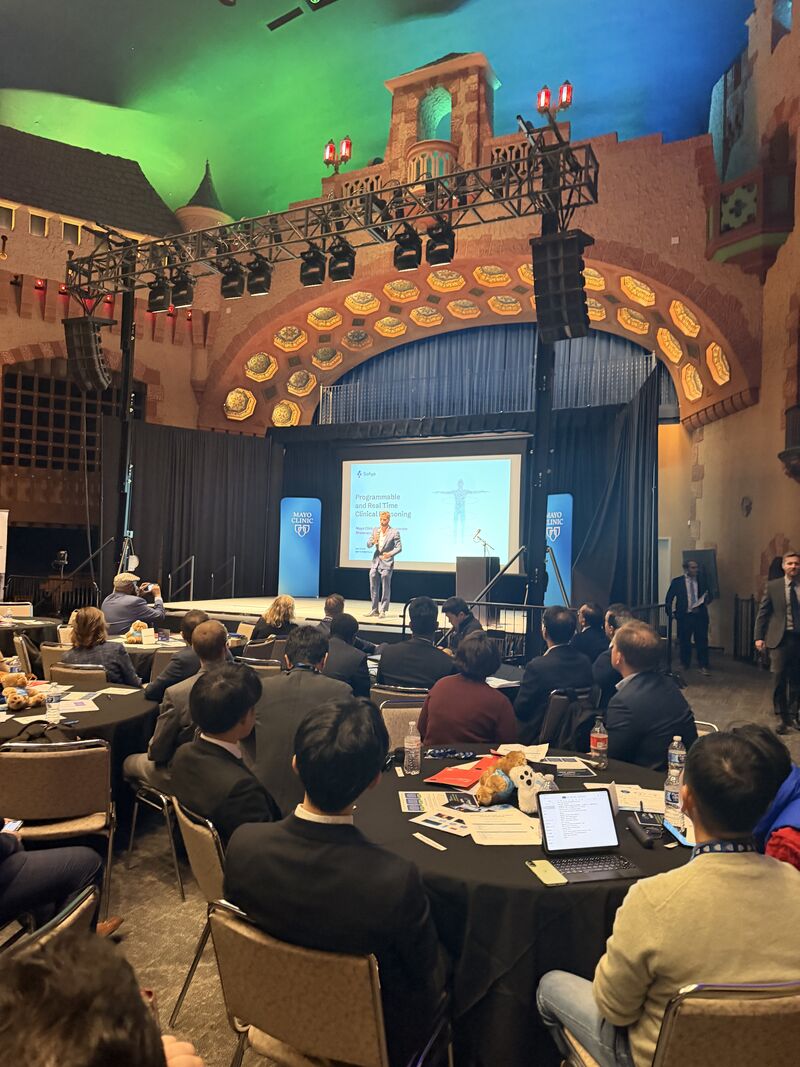
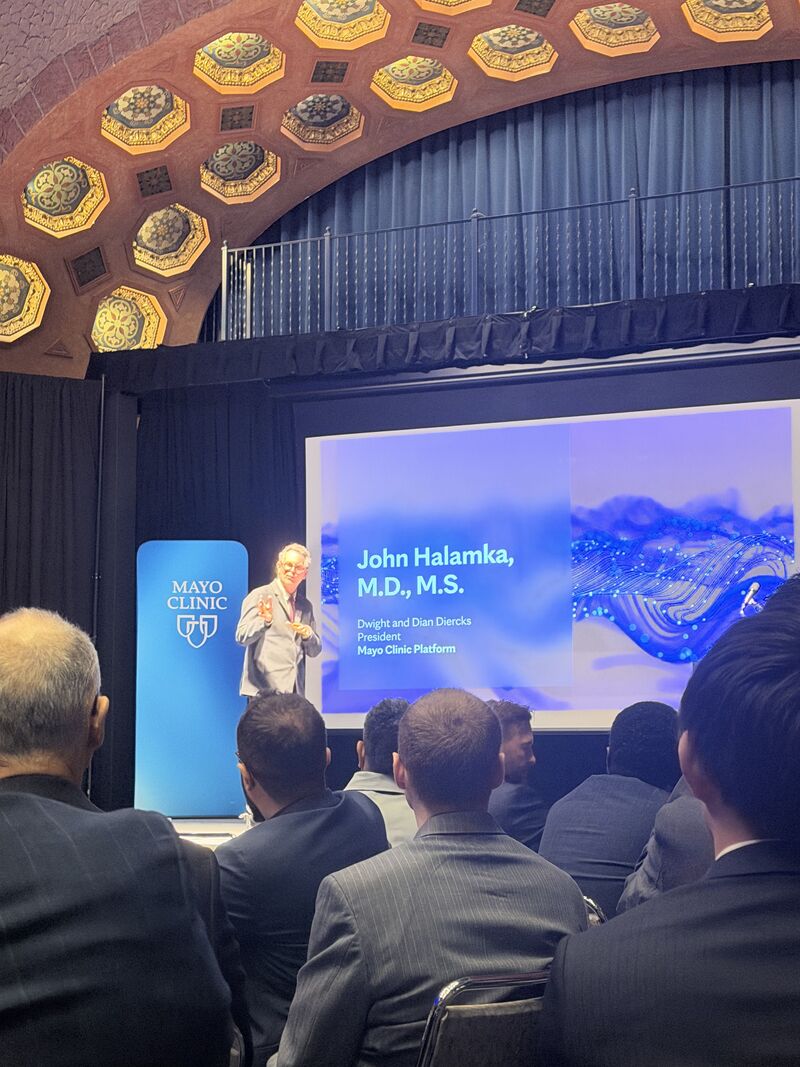
The showcase brought together the product direction, the precision care research, and the validation context built throughout the program.
The programmable clinical reasoning vision presented at the final showcase.Igor Couto · Sofya ↗The platform environment in which the research direction was challenged.Igor Couto · Sofya ↗